
On Candles And Creativity
Chanukah: Living the law, shaping the law

Antagonists towards religious life have accused it of quashing human creativity. When thinkers like Nietzsche engage in such lines of attack, they are not alleging that the religious individual cannot become an artist or poet, but rather that to live in accordance with a pre-determined dogma fundamentally crushes the spontaneous, life-affirming instinct of the self. As Jews, we find profound beauty in the halachic minutiae that cover every aspect of our daily living. Famously, there are even detailed guidelines as to how to tie one’s shoelaces. But with such a ubiquitous legal tradition, can we ever be said to be engaging any personal ingenuity? After all, we appear to inhabit a system which prevents spontaneity and self-legislation. Of course, this is not a classical ‘argument’ against religion or Judaism. You are perfectly within your rights to reject creativity as being a worthwhile ideal. If, however, you do regard self-expression as a part of what it means to be human. Carry on reading.
Responding to the secular assault above, we can convincingly argue that its core assumptions about the nature of halacha rest on false premises. Let me explain.
Whilst modernity’s proliferation of halachic literature has had a myriad positive effects, its pervasiveness has ironically eroded our sense of Jewish law’s living, breathing DNA. The fact that the layman engages with halacha in calcified, textbook-like formats belies the fact that Jewish law is the very arena in which human creativity becomes a covenantal act. Far from being a static code handed down as a closed system, the ever-evolving corpus of Torah She-Be’al Peh is at least as formative as it is receptive. Its very mode of existence is dynamic expansion through human thought. The wonderful book Nietzsche, Soloveitchik, and Contemporary Jewish Philosophy highlights Nietzsche’s own words:
“True philosophers are commanders and legislators… their knowing is creating, their creating is a legislating…”
and replies with Rav Soloveitchik’s description of the Torah-centric scholar:
“Halachic man received the Torah from Sinai not as a simple recipient but as a creator of worlds, as a partner with the Almighty in the act of creation. The power of creative interpretation (chiddush) is the very foundation of the received tradition… The essence of the Torah is intellectual creativity.”
Thus, halacha fosters precisely the virtues Nietzsche believes religious lawmaking destroys.
Now, I must admit, I don’t find this solution entirely satisfying. One can’t help but feel it limits creative living to an elite intellectual cadre of Torah scholars. Admittedly, such a conclusion would sit fine with Nietzsche, who felt that value-creation was the remit of an exceptional minority. But surely Judaism’s take here is different? No doubt ours is a religion that reveres exceptional Torah leaders. They are the Enei Ha’Eidah, the eyes of the people. Yet we also possess strong traditions conferring unique sanctity upon the individual. “Bishvili nivra olam,” – the world was created for me – declared the sages, and generations of thinkers have taken this to mean that my existence, your existence, anyone’s, carries its own cosmic purpose.
So, the issue we seem to have here is that for the masses of religious Jews, halachic observance is bereft of creative expression. I want to suggest that, although this may superficially appear to be the case, it isn’t true.
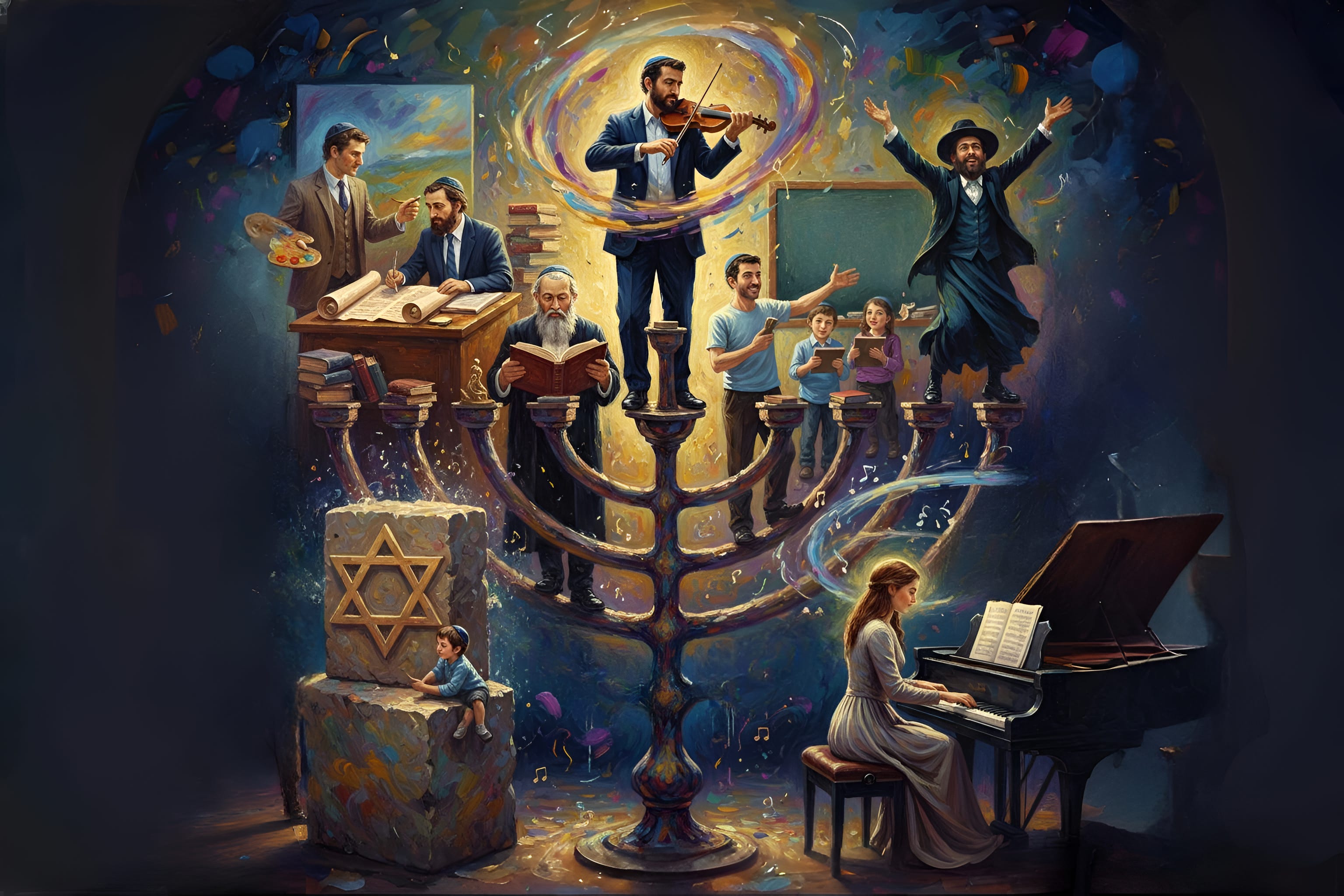
Chanukah is celebrated as the Chag most associated with Torah She-Be’al Peh. Historically, it occurred in the vacuum left by the end of prophecy, when Judaism could no longer lean on direct divine instruction for religious clarity. This absence necessitated a new type of decisiveness, achieved through debate, interpretation, and careful reasoning. These were to become hallmark characteristics of Torah She-Be’al Peh. So, if we are looking for how communal creativity might slip into the halachic process, Chanukah is as good a place to start as any.
In his fourteenth Chanukah ma’amar, Rav Hutner draws attention to an unusual formulation in Al HaNissim:
‘ve-achar kach ba’u banecha – and afterwards, your children came’
There is no parallel phrasing in the Purim liturgy. Something about Chanukah seems to demand a focus on the role of the people themselves.1
Rav Hutner’s explanation requires us to reconstitute our understanding of the halachic process. We imagine there to be a clean hierarchy. Horah, the deliberate legal ruling of the Beis Din, sets the standard, and maaseh, the conduct of the people, conforms to it. While correct as far as it goes, this model misses an essential layer. Halacha also develops from the bottom up. In Rav Hutner’s formulation, there are scenarios in which the inverse occurs, where the practices embraced by a community affect the rulings of the Torah elite.
I find Dr Moshe Koppel’s analogy of halacha as a language useful for clarifying this idea.2 In natural language, authoritative grammar arises from a negotiation between formal rule-makers and everyday speakers. If I invent a phrase like “flomble bork wazzle,” it stays gibberish because individuals can’t force usage that contradicts a language’s most obvious rules. Yet slang such as “selfie” or “to ghost someone” can enter formal grammar once the community adopts it as part of everyday speech. Similarly, even when a posek’s analysis of canonical sources provides an absolute conclusion, he will try to measure any final decision against the entrenched practices of his community. Customs embraced by subsects of Klal Yisroel can, over time, enter the halachic framework with near-binding authority. And rulings that most people cannot integrate into religious life lose their practical halachic standing. All of us, in other words, are taking a subconscious part in a millennia-long halachic conversation.
Every private legal proceeding requires two modes of clarification. The first is clarification through reasoning, entrusted to judges; the second is clarification through credibility, entrusted to witnesses. Rav Hutner posits that this identical pattern exists on the national scale when it comes to determining halacha. Here, too, we encounter clarification through the abstract reasoning of the Beis Din and clarification through the witness-like authority of Klal Yisroel, whose religious practice unconsciously reveals the Divine will. Rav Hutner reminds us of the Jewish nation’s title Adas Hashem, the assembly of God. Adas, he points out, shares the same Hebrew letters as the word eidus – testimony.
We can now appreciate why the Chanukah version of ‘Al Hanissim’ uniquely foregrounds the Jewish people as active participants in the festival’s formation. After all, the rabbinic enactment of this new festival could only be completed by communal assent, a foundational pillar of Torah She-Be’al Peh.
Earlier, I proposed that the capacity for halachic creativity extends beyond a circle of scholarly elite and that, in fact, a parallel, if quieter, mode of expression exists within every one of us. Clearly, the man on the street cannot formally legislate halacha; such activity demands learning, authority, and recognised standing. Yet, building off Rav Hutner’s analysis, I would like to argue that the very act of taking part in religious Jewish life is inherently creative.
Think about it. Throughout life, an observant Jew makes innumerable small but spiritually oriented decisions. Choices range from which Rabbi to trust to communal affiliation, personal standards, or inherited customs. Taken individually, such acts may appear trivial. Barely worth mentioning. Yet in aggregate, they form a powerful, if unconscious, force. Together they shape the contours within which future halachic decisions will be made and define the lived reality to which those decisions must respond. In this sense, the everyday choices of ordinary Jews do not merely reflect Orthodox Judaism as it exists; they actively participate in constructing what it will become.
The Talmud records a dispute between Beis Shammai and Beis Hillel over how the Chanukah lights are supposed to be lit. Beis Shammai rule that one begins by lighting all eight candles on the first night and then diminishes the light with each passing day. Beis Hillel, however, insists on the opposite movement, where one starts with a single flame and adds another each night until the menorah stands fully lit on the eighth day. As so often in their disagreements, halacha follows Beis Hillel.
Later commentators offered symbolic interpretations of Beis Hillel’s ruling. The growing light becomes a metaphor for the unfolding power of Torah She-Be’al Peh, its ever-expanding illumination. From within this interpretive framework, Chassidic thinkers turned back to Beis Shammai’s position and asked what metaphysical intuition might lie beneath the idea of diminishing light. Their answer rests on a distinction between two kinds of illumination. There is a light that becomes more perceptible as it intensifies. Yet there is also a light whose very brilliance overwhelms the senses. The more it is revealed, the more it evades our perception.3 The Psalmist gestures toward this paradox when he speaks of God as both “enwrapped in light” and as one who “makes darkness His concealment”. To stare directly into the sun is not to see more, but to see nothing at all.
These two modes of light, I would suggest, correspond to the two pillars of Torah she-be’al peh we have traced thus far. The first embodies the manifest radiance of the sages, whose deliberate creativity shapes the halachic landscape in plain view. The second is a hidden light found within every Jew. Hidden not because it is dim, but because it is a spark of God, a cheilek Elokim mima’al. It works through the simple act of living a religious life, such that ordinary participation itself becomes a medium through which Torah she-be’al peh continues to unfold and be created anew.
One way or another, as we light our menorahs this year, we should do so ‘as a creator of worlds, as a partner with the Almighty in the act of creation’.
Keep Pondering and Enjoy The Rest Of Chanukah!
If you enjoyed reading this, feel free to click the ❤️ button on this post so more people can discover it on Substack 🙏
In Pachad Yitzchak, Rav Hutner also presents a logical argument for why Chanukah, specifically, centres on the people’s role in effecting hora’ah, whereas this emphasis is absent from Purim, despite Purim likewise being rabbinically instituted. I chose not to include this discussion in the main body of the essay. Its cited below
סוגיא דגמרא דאמרה על בית דין של אנשי כנסת הגדולה שהיו בהם ק”ך זקנים ומהם כמה נביאים. ומדחשבינן לה לעדיפות בשם בית דין, שמע מינה שיש בזה היכי תמצא של יפוי כח בהוראה. והשתא הא דפריך ריש מגילה שאי אפשר הוא שחכמי המשנה יבטלו תקנת בית דין של אנשי כנסת הגדולה משום דאין ב”ד יכול לבטל דברי ב”ד חבירו אלא אם כן גדול הימנו בחכמה, אין הכוונה משום שמעשה שהיה כך היה, שבית דין של אנשי כנסת הגדולה היו גדולים בחכמה מבית דין של אחריהם, אלא מפני שאי אפשר אחרת. דהרי בבית דין של אנשי כנסת הגדולה ישבו בה נביאים ואז נחתמה הנבואה ונסתלקה מישראל, הרי ממילא מוכרח כי אחרי בית דין של אנשי כנסת הגדולה לא יהא ב”ד גדול ממנו בחכמה. וכל זה היא בפורים שהוא תקנת ב”ד של אנשי כנסת הגדולה, אבל בחנוכה, שהיא תקנתם של ב”ד של חשמונאים, הרי בודאי שאין שום הכרח בהלכה שלא יעמוד אחריהם ב”ד גדול בחכמה מהם. והנה כחן של תקנות בישראל נבנו על שני עמודים: גדולתו של הבית דין מתקני התקנה, והתפשטות התקנה בכלל ישראל. ומכיון שחנוכה הוא המועד היחידי שאין שום הכרח בהלכה כי אותו הבית דין שתיקנוהו הוא הב”ד הגדול מכל הבתי דין שיעמדו אחריו; הנה ביחס לכל המועדים, עיקר סמיכתו של מועד החנוכה הוא על העמוד השני של כח התקנה, דהיינו ההתפשטות בכלל ישראל
Excellent conversation around the topic here: https://18forty.org/podcast/dr-moshe-koppel-halacha-as-a-language/#
Fascinatingly, the Shem MiShmuel contends that this is the meaning behind Yitzchak’s blindness
You’re calling “creativity” what’s really permissioned variation inside a cage where anything genuinely new or creative gets disciplined or banned. There’s no genuine self-expression. Your freedom ends when your rabbi says it ends.
I hear your point but "As Jews, we find profound beauty in the halachic minutiae that cover every aspect of our daily living. Famously, there are even detailed guidelines as to how to tie one’s shoelaces" is a bit disingenuous.
Finding beauty in a routine is not the same as creative beauty.
Art is based on the human condition as it is, and religion is based on ideals so they are a bit contradictory.
I don't think religion suppresses creativity if there is honesty and recognition that we don't always live up to ideals
Rav Kook suggested that the teshuva process could be the fertile ground for art as it combines the spiritual striving with human failings.